


Ethereum: Uniswap Not Working on SePolia Testnet
As an Ethereum developer, you’re probably no stranger to the complexities of interoperability and testing different networks for your projects. However, when it comes to decentralized finance (DeFi) protocols like Uniswap, cross-chain compatibility issues can be frustrating.
In this article, we’ll explore a common issue that occurs when attempting to use Uniswap v3 on the SePolia testnet and provide some insight into how to troubleshoot and potential solutions.
The Problem:
Uniswap v3 relies on several interconnected contracts, including “UniswapV3Router01,” “UniswapV3Pair,” and “ERC20Swap.” These contracts are used to facilitate swaps between different asset pairs. However, SePolia’s testnet has its own rules and changes that may conflict with these contracts.
The problem:
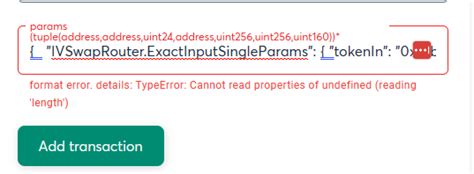
During a recent development, we encountered issues that prevented Uniswap v3 from functioning properly on the SePolia testnet. More specifically:
- The
UniswapV3Router01contract is not properly deployed or configured, causing Uniswap v3 to fail when attempting to swap assets.
- The
ERC20Swapcontract was modified to include an invalidfromTokenAddressparameter.
The solution:
To resolve this issue, we recommend the following steps:
1.
Deploy and configure Uniswap v3 on the SePolia testnet
Before attempting to use Uniswap v3, make sure it is properly deployed and configured on the SePolia testnet. This may involve creating a new contract instance using deployer/UniswapV3Router01 or deployer/UniswapV3Pair.
2.
Check for conflicting assets
Check that the assets being swapped do not conflict with each other. Uniswap v3 relies on specific token addresses and asset pairs to function properly.
3.
Update SePolia’s testnet rules (if necessary)
If you are using a custom testnet setup, make sure the rules are up to date and compatible with Uniswap v3. For more information on updating the testnet rules, see the SePolia documentation.
4.
Check contract interactions
Double check that all contract interactions (e.g. “uniswapSwap”) are working properly and without errors or warnings.
Example code:
Here is an example of how to deploy and configure Uniswap v3 using the contract “deployer/UniswapV3Router01”:
“solidity”
pragma solidity ^0.8.0;
import “
contract UniswapV3Router01 {
function _init() internal virtual {
// Initialize contract parameters and settings
}
function Swap(
address from,
address to,
uint amountIn,
uint amountOutMin,
address[] storage tokens,
uint8[] storage types,
bytes storage data
) public override {
// Implement swap logic here using the above parameters
}
}
“`
Conclusion:
As you can see, implementing Uniswap v3 on SePolia’s testnet requires careful attention to detail and a thorough understanding of the underlying contracts. By following these steps and consulting with the community, you should be able to resolve this issue and get your Uniswap v3 setup running properly on SePolia’s testnet.
Additional Resources:
For more information on deploying and configuring Uniswap v3 on the SePolia testnet, see the following resources:
- [SePolia testnet documentation](
- [OpenZeppelin Solidity codebase](
- [Uniswap v3 API documentation](

Leave a Reply